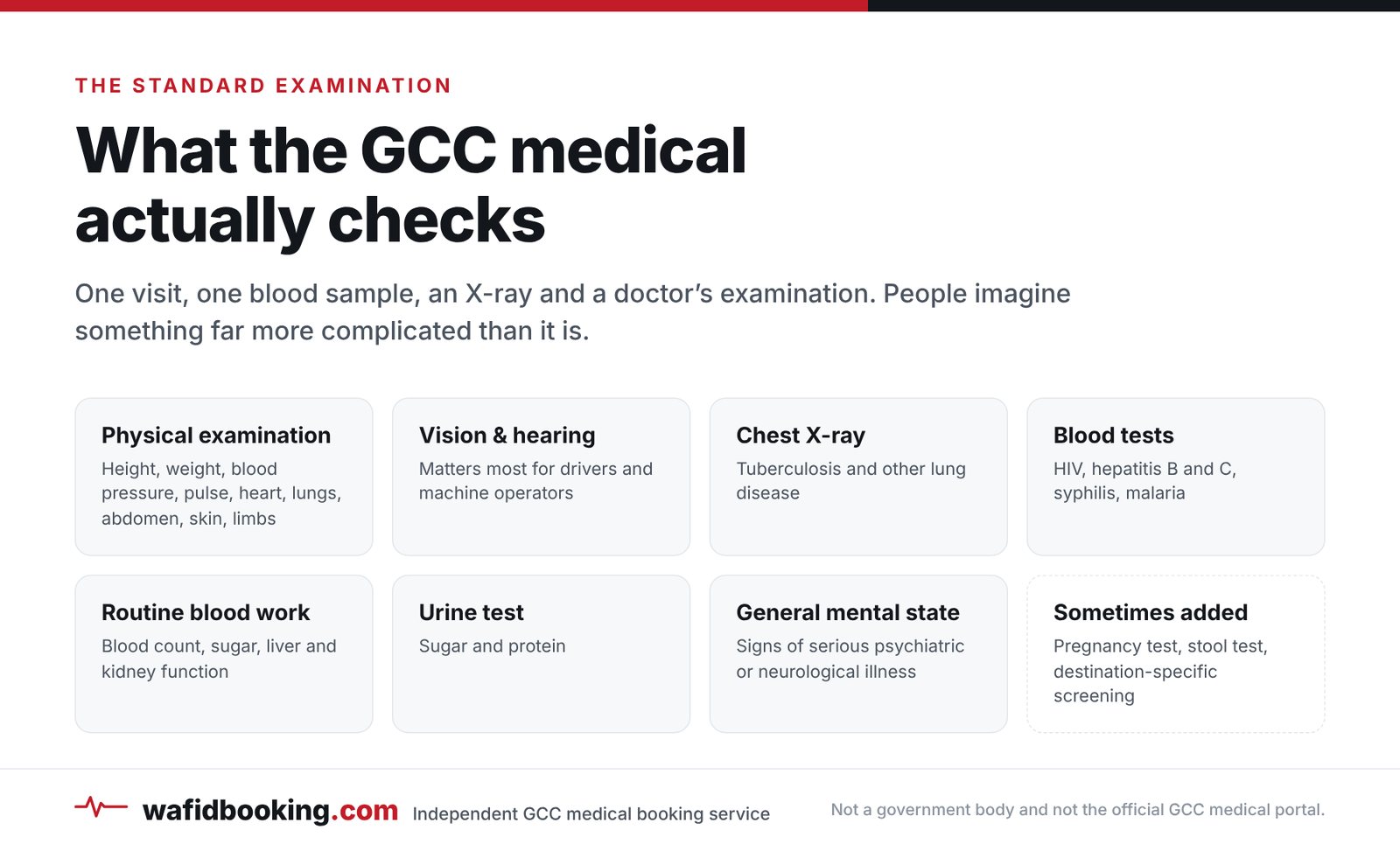
Nearly every applicant who messages us before an appointment asks a version of the same thing: what will they actually test? People imagine something far more complicated than it is. One visit, one blood sample, an X-ray and a doctor's examination.
Here is the full list, what each part looks for, and how to get through the morning without problems.
The standard examination
| Part of the examination | What it looks at |
|---|---|
| Doctor's physical examination | Height, weight, blood pressure, pulse, heart, lungs, abdomen, skin and limbs |
| Vision and hearing | Eyesight and basic hearing, important for drivers and machine operators |
| General mental state | Signs of serious psychiatric or neurological illness |
| Chest X-ray | Tuberculosis and other lung disease |
| Blood tests | HIV, hepatitis B, hepatitis C, syphilis and malaria |
| Routine blood work | Blood count, blood sugar, liver and kidney function, and at many centres your blood group |
| Urine test | Sugar and protein |
What each part involves
The doctor's examination
A doctor records your height, weight and blood pressure, then examines your heart, lungs, abdomen, skin and limbs. Eyesight and hearing are checked as well.
For driving jobs the eyesight check matters more than applicants expect, so bring your glasses if you use them.
The chest X-ray
This looks for tuberculosis and other lung conditions. It takes a minute and needs no preparation. If you are pregnant, tell the staff before the X-ray, not after.
The blood sample
One sample covers both the infectious disease screening and the routine blood work. In a normal examination you give blood once.
The urine sample
Checked for sugar and protein. Some centres also use it to screen for drug use.
Extra tests for some applicants
Not everyone has the same panel. Depending on your job category and destination, the centre may also carry out:
- A pregnancy test, for women in certain visa categories
- A stool test, usually for food handlers and domestic workers
- Additional screening required by a particular destination country
- Vaccination checks for some visa types
Requirements vary a little between Gulf countries. Our pages for Saudi Arabia, the UAE, Kuwait, Oman and Bahrain cover what changes and where.
How to prepare
Do I need to fast?
Fasting is generally not required. A light meal beforehand is fine. If you take regular medication, carry it and mention it at the counter, and take your medicines as your own doctor has instructed.
The day before
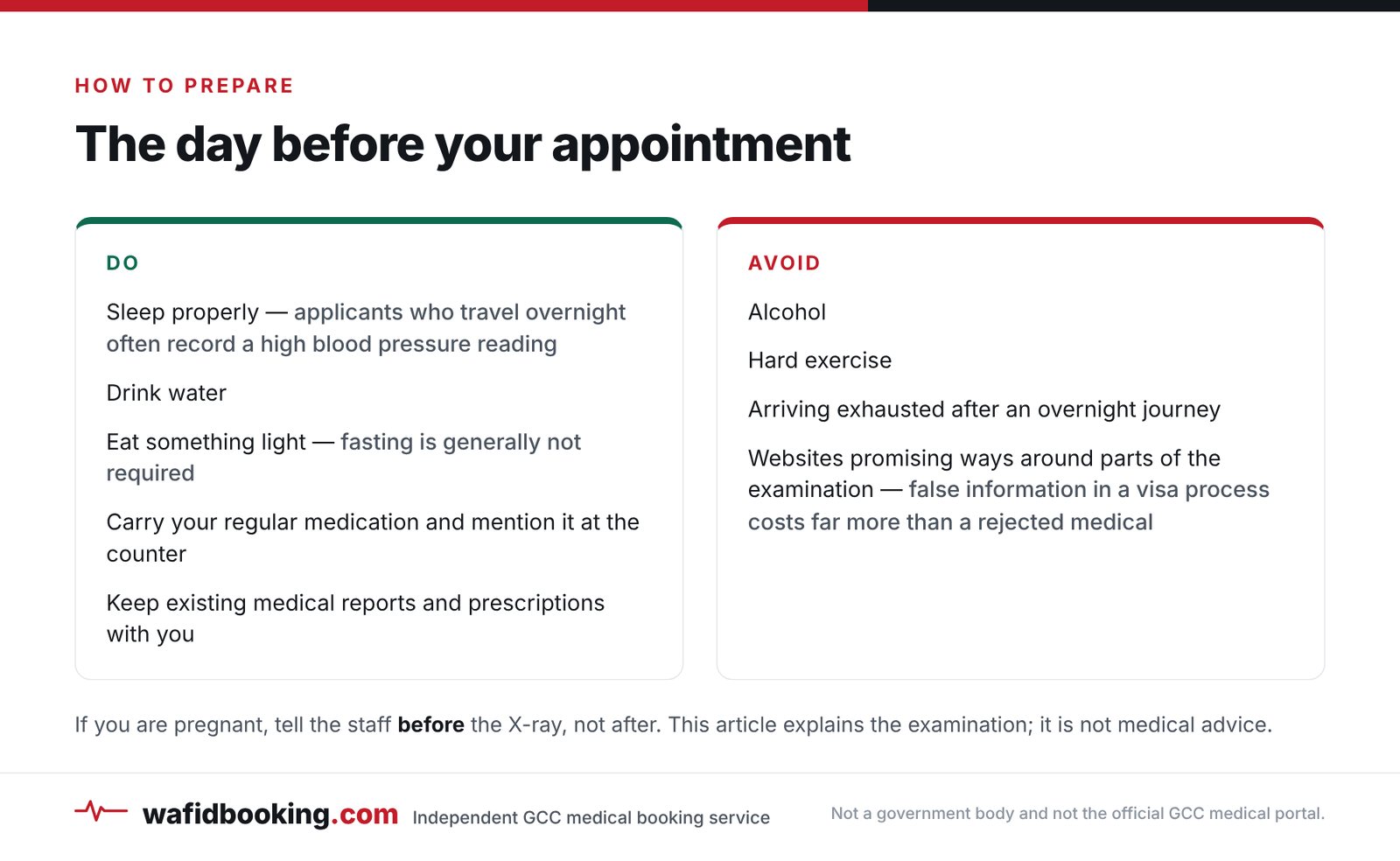
- Sleep properly. Applicants who travel overnight and arrive exhausted often record a high blood pressure reading.
- Drink water.
- Keep any existing medical reports and prescriptions with you.
- Avoid alcohol.
- Avoid hard exercise.
What to carry
- Original passport, plus a photocopy
- Your printed appointment slip
- Passport-size photographs, normally three, though your centre may ask for a different number
- Cash for the centre fee
- Glasses, if you wear them
- Sri Lankan applicants: your NIC or NICOP
On honesty
Some websites promise ways around parts of this examination. Avoid them. False information in a visa process costs far more than a rejected medical, and we will not assist with anything of that kind.
How long the visit takes
The examination is usually finished in one visit. The queue takes longer than the tests, so arriving early makes a real difference. Blood samples are normally taken in the first part of the day.
Results are generally published within 24 to 72 hours. You can check your result with your passport number, and track your booking while it is being processed. The status moves through Payment Received, Under Review, Processing and Completed.
Appointment slip
Valid from the date it is issued.
Medical result
Valid once it is published.
Fit and Unfit
The result is either Fit or Unfit. That decision belongs to the examining doctor and the medical authority. It cannot be changed by us, by your agent, or by anyone who offers to do it for a fee.
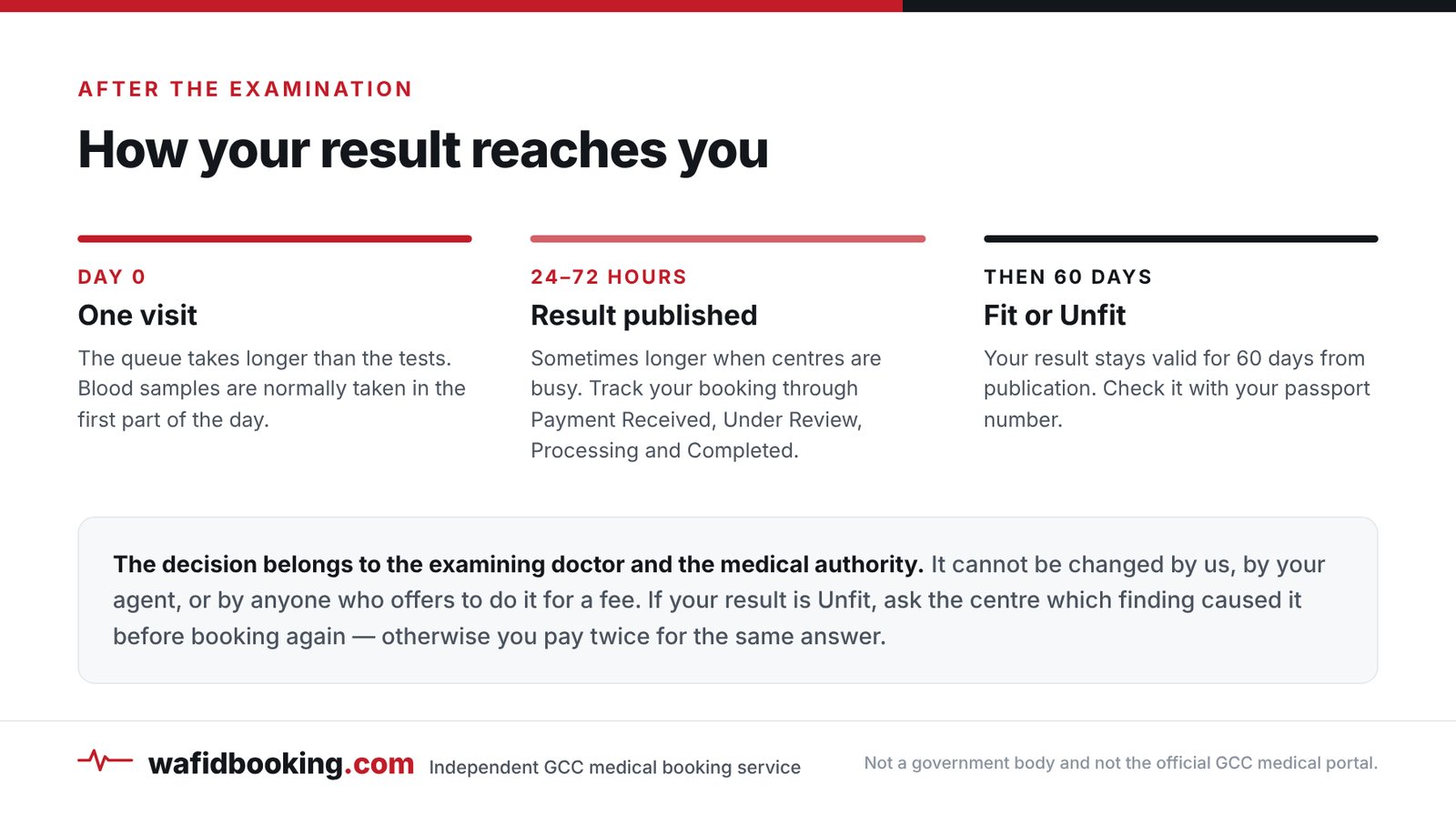
If your result is Unfit, ask the centre which finding caused it. Some findings are temporary and another examination later is possible. Others are not. What you should not do is immediately book again without knowing the reason, because you will pay twice for the same answer. Our guide on report validity and unfit results explains more.
Anything to do with your own health is a conversation for a doctor, not a booking service. We help with appointments, not medical questions.
Frequently Asked Questions
Which tests are done in the GCC medical?
A doctor's physical examination, a chest X-ray, blood tests for HIV, hepatitis B and C, syphilis and malaria, routine blood work including sugar and liver and kidney function, and a urine test.
Is fasting required?
Generally not. Eat something light beforehand, and mention any regular medication at the centre.
Is the test list the same for every Gulf country?
The core examination is the same for Saudi Arabia, the UAE, Kuwait, Oman, Bahrain and Yemen. Some destinations add extra checks. Qatar runs on a separate process and is not booked through us.
Will they take blood more than once?
No. One sample covers the full panel in a normal examination.
How many days until my result?
Usually 24 to 72 hours, sometimes longer when centres are busy.
How long does my result stay valid?
60 days from publication. Some employers ask for a more recent one.
Is a pregnancy test included?
For women in some visa categories, yes.
Can I take the test at any hospital?
No. Only approved centres can carry out this examination and upload the result. See our approved centres list at wafidbooking.com/medical-centers.
Official sources
Rules on the examination, fitness criteria and report validity are set by the GCC authorities, not by Wafidbooking. Check the current position with:
- wafid.com, the official Wafid (formerly GAMCA) portal for booking and checking medical examinations.
- Gulf Health Council, the GCC body that approves medical centres and sets the expatriate health screening programme.
- The embassy or consulate of your destination country, and your employer, for visa-specific requirements.
Ready for your appointment?
Book at any hour and your confirmation PDF is emailed to you, usually within about five minutes. Our booking fee is US$18, or ₹1,200 from India, paid by card. The centre charges its own examination fee on the day, generally US$80 to US$100, or ₹7,500 in India.